Archive for the ‘Long Term Outlooks’ Category

Georgia is Exceptional Drought Free

Thursday, March 20th, 2008

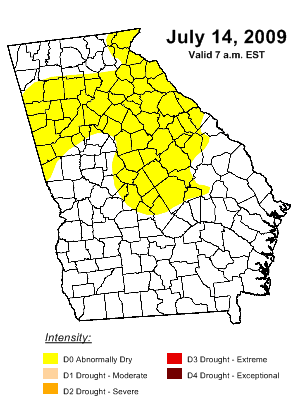
For the first time since July, 2007, none of Georgia is experiencing exceptional drought conditions. The most recent Georgia drought monitor shows that 46% of the state is drought free, and that parts of southern Fulton, DeKalb and Gwinnett counties have improved to the severe drought category, a step up from the extreme drought conditions seen further north.

Including the 1.15 inches of rain that fell yesterday at the Atlanta airport, we are above normal for March precipitation, and only down 1.79 inches for the year.  Last year at this time, only 7.89 inches of rain had fallen in Atlanta, so we’re way ahead of last year.  Lake Lanier is responding as well, rising about a third of a foot from the rain yesterday.

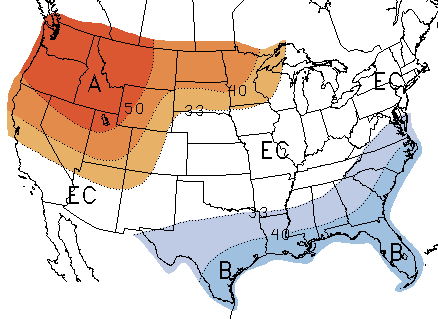
The drought outlook continues to call for improvement in the parts of Alabama and Georgia that were hardest hit last year, and some improvement for  the remainder of North Georgia, South Carolina and North Caroliina.  This outlook parallels the latest monthly precipitation outlook for April:

(more…)

Sphere: Related Content

Drought Recedes as Winter Ends

Saturday, March 1st, 2008

While the vernal equinox isn’t for another three weeks, from a weatherman’s perspective, today is the first day of spring. And it looks like for the next two weeks or so, spring is going to be colder and wetter than normal, so take advantage of the nice weather this weekend while it lasts.

Beginning on Monday evening, another round of storms should hit much of the east coast, including Georgia. The latest hazards outlook is calling for a chance of severe thunderstorms Monday evening and Tuesday, and is also calling for some significant drought relief from the rain the storms will bring. Another front passing through later in the week could bring some rain, but it is more likely to introduce some cooler weather, with high temperatures next week at this time in the low 50s.

The 6-10 day outlook is calling for colder than normal temperatures, and greater than normal precipitation in north Georgia, while the 8-14 day outlook continues the cold trend and brings precipitation back to normal. For the month as a whole, the outlook is for warmer than normal temperatures, and normal rainfall.

(more…)

Sphere: Related Content

February Starts Warm, but May Turn Colder

Monday, February 11th, 2008

For the moment, the weather seems to be running about a month ahead of the calendar. With daytime temperatures in the upper 60s for the past few days, Atlanta is now running about 5.5 degrees above normal in February. Enjoy the nice weather while it lasts, because the current thinking by the meteorologists is that a cooldown is ahead, beginning this weekend.

For the first part of President’s day week, highs will be in the upper 40s to mid 50s, with lows in the low 30s. Later in the week, we could get back to high temperatures around 60, but keep in mind that the normal high for late February is 59. The Weather Service’s 6-10 day and 8-14 day outlooks both call for colder than normal temperatures for much of the eastern US. With a ridge in the western part of the country, and a trough expected for the east, it would be reasonable to expect some rain, and it looks like we’ll get that, at least for the early part of the long range period.

(more…)

Sphere: Related Content

December Likely to be Warm and Dry in the Southeast

Thursday, November 15th, 2007

Today ended up being a big day for releasing weather data and forecasts, so let’s take a look at the news:

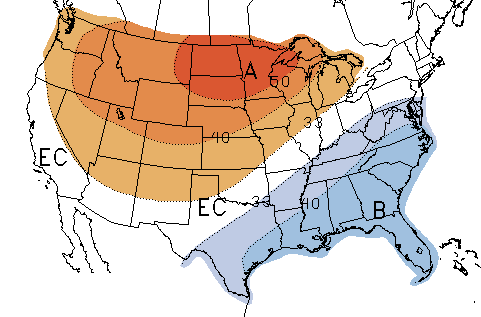
First of all, the Weather Service issued its final Winter 2007-08 forecast. Because of the strengthening La Nina in the Pacific, the revised forecast slightly extends the boundaries of the wet/dry warm/cold areas it predicted in it’s preliminary October forecast. If conditions go according to the forecast, it’s going to be wetter than normal in the Pacific Northwest and in the Ohio/Tennessee Valleys, and drier than normal for much of the southern half of the country, including virtually all of Georgia. It’s also going to be warmer than normal for most of the country, except the Pacific Northwest, with the heart of the heat in the Plains States.

(more…)

Sphere: Related Content

In Georgia, the Effects of La Nina Depend on Her Strength

Thursday, October 25th, 2007

Georgia State Climatologist David Stooksbury held a press conference today in Athens to discuss the latest Georgia drought conditions, and to explain what he thinks might occur weather-wise over the winter and spring of 2008. Much of what might happen through the next six months depends on the strength of the developing La Nina, including the chances of being able to refill, at least partially, Lakes Lanier and Allatoona.

There is now general agreement that La Nina conditions are developing in the Pacific. La Nina, and her partner El Nino, are descriptions of the two phases of the warmth of the Pacific Ocean surface temperatures compared to normal. In El Nino conditions, temperatures are warmer, while the reverse is true for La Nina. Most climate observers feel that La Nina conditions strengthened in September.

In a press release accompanying the news conference, Stooksbury said,

“The effects of the La Niña pattern differ with its strength. These differences are critical across north and central Georgia, potentially having major impacts on the current drought and the region’s ability to recover this winter and spring.”

Impact on La Nina on Georgia PrecipitationIf the La Nina conditions remain weak, then there is actually a greater chance of precipitation across extremely north Georgia, and normal precipitation across the piedmont area. In a moderate to strong La Nina, the chance of more than usual precipitation will be limited to the extreme northwest corner of the state. In either case, it’s likely to be warmer and drier over the southern half of the state. You can see the impacts in the image to the right (click on it for a larger version.)

We had best be hoping for a weak La Nina pattern. In the words of Stooksbury,

“If a moderate La Niña pattern develops, there is a high likelihood that north and west Georgia won’t be able to recover from the drought this winter.

The extreme- to exceptional-drought regions of the state may muddle through the winter and early spring. But without significant recharge of the soil moisture, groundwater, streams and reservoirs, conditions next summer could become catastrophic.”

Sphere: Related Content