US Drought OutlookThe Seasonal Drought Outlook is issued on the third Thursday of the month, and updated on the first Thursday. These outlooks analyze recent precipitation, weather forecasts, and expected trends to determine improvement or worsening of drought conditions. 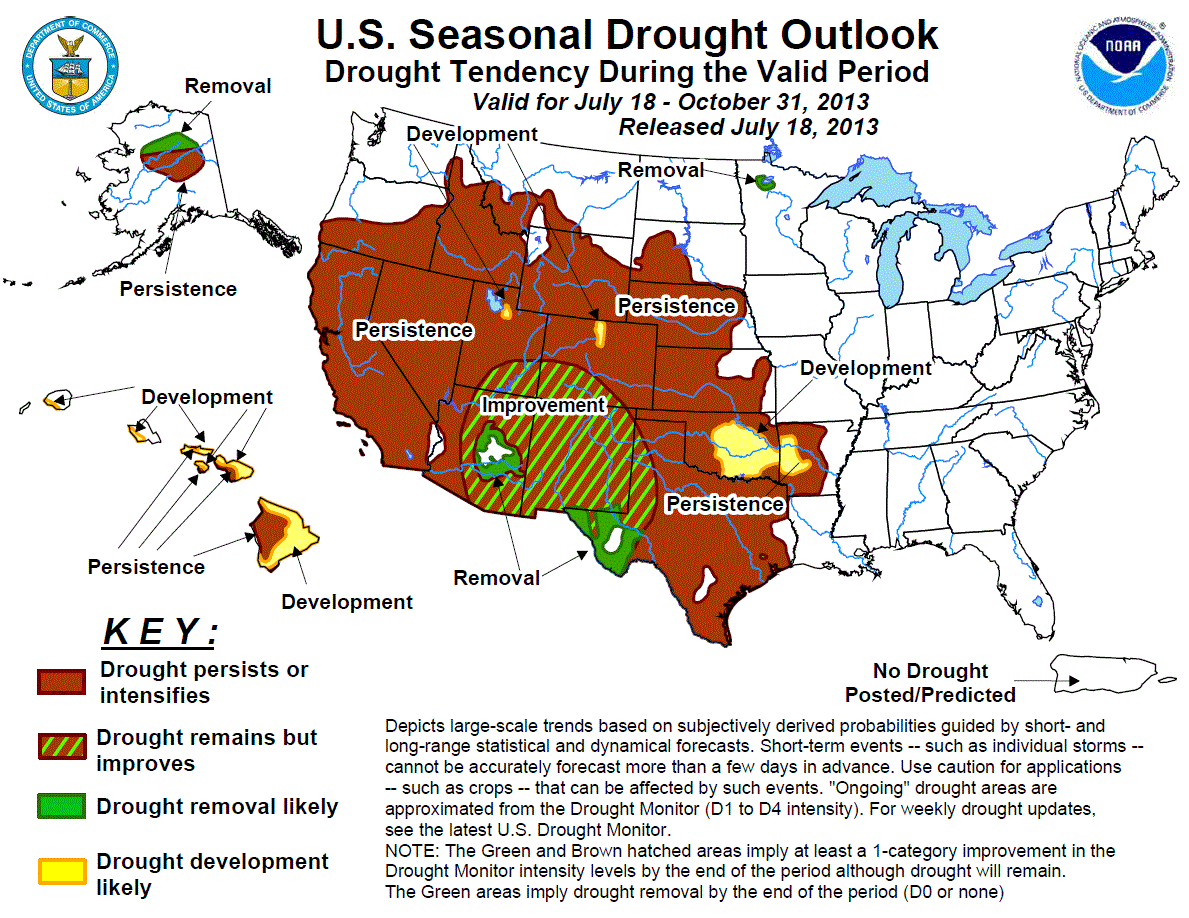 Latest Seasonal Assessment - June 16, 2010ENSO-neutral conditions developed during the first part of June, but in the wake of the 2010-2011 La Nina, widespread drought developed and persisted across the southern tier of the U.S. Significantly, over 65 percent of the current drought areas are extreme or exceptional, with many areas experiencing record precipitation deficits. During the previous three weeks, drought generally persisted or expanded across portions of the southern Plains, lower Mississippi Valley, and the southern Atlantic states. Several thunderstorm complexes and the outer bands of Tropical Storm Arlene brought localized relief to eastern and far southern Texas, while unseasonably hot, dry weather sparked a flash drought in eastern Oklahoma and southern Arkansas. During the previous week, monsoon thunderstorms began firing across the Four Corners states, while consistent thunderstorm activity across southern Florida indicated the beginning of the delayed rainy season. Drought improvement is expected across much of the Southwest and Florida during the upcoming three months as seasonal thunderstorm activity continues. Enhanced chances of above-median rainfall across the southern Atlantic states also favors drought amelioration. In contrast, a dry climatology and expected above-median temperatures during the summer months across the southern Plains and lower Mississippi Valley limits opportunities for drought reduction, with further development possible across portions of Texas and Arkansas where abnormal dryness is already present. Across the remainder of the Southeast, some improvement is possible under a summertime convective regime, although rainfall deficits are substantial and long-term in some areas, particularly across Louisiana. The prospect of tropical cyclones, with an expected above-normal season peaking in September, adds to the forecast uncertainty. Across Hawaii, leeward drought persistence is expected under the summer trade wind regime. Discussion for the Seasonal Drought OutlookTools used in the U.S. Drought Outlook (USDO) included the official CPC temperature and precipitation outlooks for July 2011 and the long lead forecast for July - September 2011, various medium- and short-range forecasts and models such as the 6-10 day and 8-14 day forecasts, the soil moisture tools based on the GFS model and the Constructed Analogue on Soil (CAS) moisture, the Climate Forecast System (CFS) seasonal precipitation forecasts, the four-month Palmer drought termination and amelioration probabilities, climatology, and initial conditions. Widespread drought conditions generally persisted or intensified across the southern Plains during the previous 30 days, as much of western Texas and eastern Oklahoma received less than 25 percent of normal precipitation. In contrast, heavy rain from thunderstorm complexes brought localized relief to northeastern Texas, while thunderstorms associated with an upper level disturbance followed by the outer bands of Tropical Storm Arlene reduced drought intensity across far southern Texas. In eastern Oklahoma and southern Arkansas, abnormal dryness coupled with high temperatures caused a rapid deterioration of drought conditions. Drier weather is typical across the eastern half of Texas and the lower Mississippi Valley during July and August, with mean precipitation increasing substantially in September across southern Texas. The climatologically drier summer pattern limits opportunities for substantial drought reduction across Texas, Oklahoma, and the Mississippi Delta region, while increased rains in September boost chances of drought improvement for southern Texas. Summertime convection and the potential for tropical cyclone activity may ameliorate some of the drought closer to the western Gulf coast. Persistence is indicated across central and northeastern Texas, central Oklahoma, and northern Louisiana, while some improvement or improvement are expected across far southern Texas and the western Gulf Coast. In southern Arkansas, recent heat and dryness coupled with the relatively dry climatology support a forecast for drought development, particularly in the short term. Forecast confidence for the southern Plains and Mississippi Delta is moderate. Below-average rainfall prevailed across the far southwestern United States during the previous 30 days, allowing drought areas to persist or intensify, though monsoon thunderstorms have commenced during the previous week. As of June 28, exceptional drought covered nearly 50 percent of New Mexico, including nearly all of the state's southern half. During July, the North American Monsoon shifts northward from Mexico's Sierra Madres into the southwestern United States, bringing scattered showers and thunderstorms which account for a significant portion of the annual rainfall. The monsoon typically peaks in July and August before decaying in September. Both the updated CPC July precipitation outlook and the July - September seasonal outlook indicate equal chances of above or below median rainfall across the core monsoon region. This outlook, therefore, favors climatology, with the North American monsoon bringing drought improvement to Arizona, western New Mexico, and portions of Colorado and northwestern Kansas. Note that drought improvement as defined in this outlook verifies as a one-category reduction on the U.S. Drought Monitor, rather than total drought elimination or substantial amelioration of impacts. Improvement is less certain across the eastern flank of the monsoon region, which includes eastern New Mexico and the Texas Panhandle region, where drought is more entrenched. Forecast confidence for the southwestern United States is low to moderate. Generally below average rainfall continued across the Deep South and southern Atlantic coastal Plain during the previous 30 days, with precipitation deficits exceeding two inches across portions of Louisiana, the southern border of Mississippi and Alabama, southwestern Georgia, the eastern Florida panhandle, and the eastern Carolinas. Drought expanded across the Carolinas and northern Georgia and intensified along the Gulf Coast, where exceptional drought covered nearly 64 percent of Louisiana and extended eastward into the Florida Panhandle and much of southern Georgia. Scattered showers and thunderstorms typically occur across the Southeast during the summer months, with the southern Atlantic coastline receiving 30 to 40 percent of its annual rainfall during the July - September period. Tropical cyclones or their remnants can also bring substantial rainfall to the Southeast during the summer or early autumn months. The CPC July - September seasonal outlook calls for increased odds of above-median rainfall across the southeastern coastal Plain and piedmont regions. Since these improved rainfall chances occur during a climatologically wet time of year for the Southeast, improvement is indicated in this outlook from the eastern Gulf Coast through the Delmarva Peninsula. Some improvement is maintained across the remainder of the Deep South. Forecast confidence for the Southeast and southern Atlantic is high. The Florida peninsula's seabreeze convergence driven rainy season, which typically begins in late May, was delayed for much of June, leading to a substantial deterioration of long-standing drought conditions across southern Florida and increasing wildfires. During the previous week, however, widespread and sustained thunderstorm activity commenced, beginning the rainy season and providing some initial short term relief. Extreme drought conditions continue across much of southeastern and far southwestern Florida, while exceptional drought remains entrenched across the Broward and southern Palm Beach County metropolitan areas. The southern half of the Florida peninsula typically receives 40 to 45 percent of its annual rainfall during the July - September period, and the CPC July - September seasonal outlook indicates enhanced odds of above-median precipitation. Therefore, further drought improvement is likely as the rainy season continues through the summer months. The Florida peninsula is also prone to tropical cyclone landfalls, which can bring substantial rainfall in short periods of time. The climatological peak of hurricane season falls in early September. Forecast confidence for the Florida peninsula is high. In Hawaii, the CPC July - September seasonal outlook indicates enhanced chances of below-median rainfall. This, coupled with the summer trade wind regime, which favors dryness on the lee sides of the islands, favors persistence of the existing drought areas in the state. Forecast confidence for Hawaii is moderate. |

